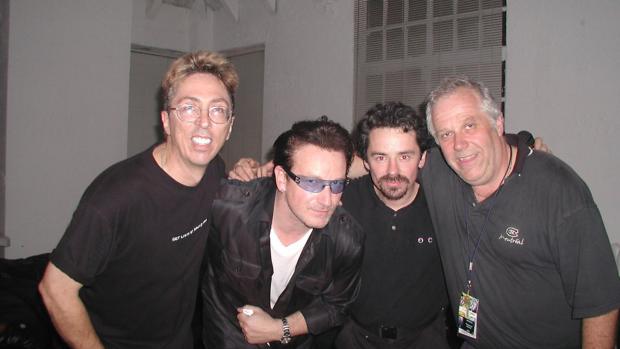
CenterStaging owner Mitch Clark had the opportunity to catch up with longtime friend and legendary production manager Jake Berry. He reflects on his career, the changes he’s witnessed, and what lies ahead for live entertainment.
How has the entertainment industry evolved during your career, and what major shifts do you foresee in the future?
Looking back, the shifts in this business have been remarkable as technology has evolved. Not only in how shows are built but also in how tours are run. When I first became a production manager in 1979, all our advancing was done by payphone. Now, a few decades later, it’s all done by email, Zoom calls, and cloud links. In theory, it’s quicker, but it also seems to eat more time rather than just talking on the phone. Still, there’s no denying the advances. Between automation, efficiencies in transport, and smarter ways of putting shows together, it’s all improved.
Looking ahead, I think residencies will continue to shape the future of this industry. You see it now in Las Vegas, where acts like the Eagles can sell nearly 50 nights at The Sphere, 16,000 tickets a show. It’s incredible! Artists are realizing they don’t need to grind through back-to-back tour dates when they can settle into Vegas, New York, Chicago, or LA for a stretch. From Adele to Bruno Mars to Céline Dion to Mötley Crüe, residencies have become the model, and I think we’ll be seeing a lot more of that.
What are your key principles for coordinating large teams involving hundreds of people?
I believe every production needs a general, lieutenants, infantry, and privates. You build your team that way, then it’s all about teamwork. It’s never just one individual. We learned that especially on U2’s 360° tour. The first loadout took 16 hours. It was long enough that it might’ve been the first time I ever actually had lunch at a gig. But by fine-tuning, we cut it down to where we could get it done in 4 hours. That kind of efficiency only comes from teamwork and organization. With hundreds of people working on a tour, you can’t have crew pulled in every direction. Departments were color-coded, stage managers kept everyone in line, and department heads made it all float. It’s all about assembling the right people.
Out of all of the major tours and events you’ve done over your career, is there any particular show that was especially significant to you?
Looking back, there are a few pivotal points in my career. My very first gig with Rick Wakeman was significant, but stepping into production management with AC/DC was the first giant leap. Then I had the chance to work with The Rolling Stones, which to me felt like winning the Super Bowl. Another milestone was U2’s 360° tour, taking what began in Barcelona and turning it into a massive touring machine with more than 50 trucks, it’s still one of the most groundbreaking designs ever! More recently, Black Sabbath and Ozzy Osbourne’s final show “Back to the Beginning” was a career highlight. It was great seeing all the bands that I’d grown up with, like Metallica and Guns N’ Roses, hanging out. Eighteen world-class acts were all there to honor Sabbath. Weeks later, Ozzy’s passing made that night even more powerful and emotional.
What was one of the more challenging shows you’ve had to put together?
I’d say one of the toughest was rehearsing with The Stones at the Maple Leaf Gardens Arena in Toronto. To pull it off, we needed towers put up and a crane brought in. The thing is, none of us knew if we could actually get the crane into the building. The trial run alone took six hours, and the driver had to be pretty spectacular because he was moving the jib around with only inches to spare. But somehow we got it in there, right between the last hockey game and the building getting condemned. A lot of people would’ve said, “Forget it, can’t be done.” But we persevered, and we rehearsed two shows in that arena. Nobody likes a challenge more than me.
What led you from large-scale concert productions into family entertainment shows?
I always wanted to be diversified in the things I did, whether it’s heavy metal, hard rock, female pop, or family entertainment. I worked on Bob the Builder, Thomas the Tank Engine, Walking With Dinosaurs, and a lot of family shows. More recently, I’ve been getting a lot more involved in the electronic world working a lot with Insomniac.
What advice would you give to the next generation of production managers?
It’s very difficult for newcomers now, with so much being controlled by big conglomerates. But we have to make sure it doesn’t stagnate. We owe it to the next generation of young people who want to enter this field to carry on and show them they’re stepping into the greatest industry in the world.
To learn more about Jake Berry and Jake Berry Productions visit his website.
About Jake Berry:
From a small village in Devon, England, to some of the biggest stages in the world, Jake Berry’s journey is the epitome of passion for live entertainment. Starting as a drum technician, Jake quickly rose to become one of the most accomplished production managers in the industry. He’s worked behind record-breaking tours for The Rolling Stones, U2, Metallica, and many more. His expertise also extends to large-scale family productions, like Bob the Builder, Thomas the Tank Engine, and Walking with Dinosaurs, to bring unforgettable experiences to audiences of all ages. Today, through Jake Berry Productions, he continues to shape the future of live events worldwide, while advocating for the next generation of talent. As Jake says, “We owe it to young people who want to enter this field to carry on and show them they’re stepping into the greatest industry in the world.”